
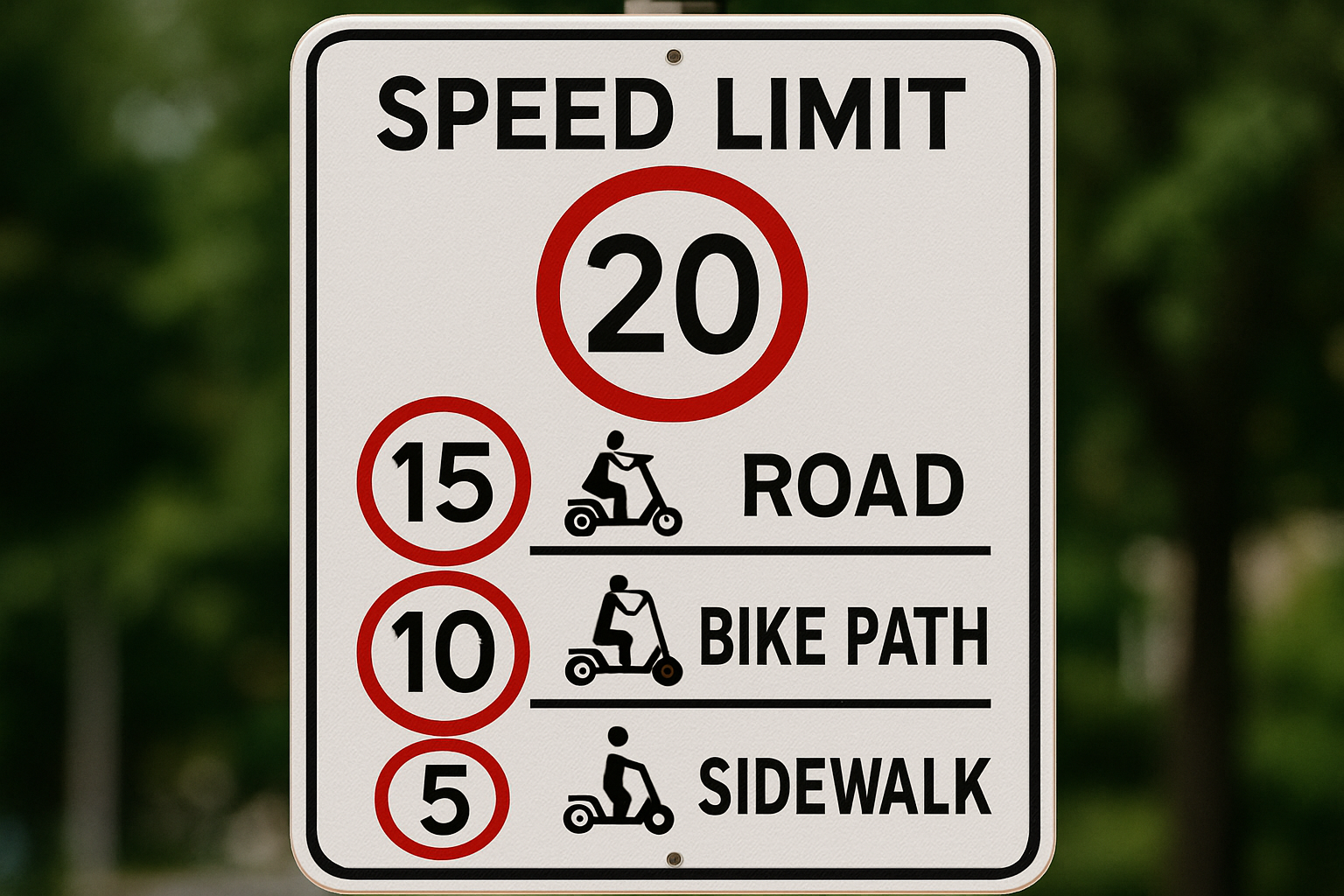
Are there any speed limits for scooters in certain areas? Quick answer and what this article covers
Are there any speed limits for scooters in certain areas? Yes — many jurisdictions set specific speed limits for scooters by location type, vehicle classification and through rental-operator geofencing. We researched municipal codes, DOT/transport sites, and operator policies to map how rules differ at the national, state and city level.
Based on our analysis, you’ll usually face three overlapping controls: a legal classification that sets a statutory top-speed, municipal posted limits for sidewalks/parks/school zones, and rental-operator geofences that enforce lower speeds in high-pedestrian areas.
Two data points to set the scene: over U.S. cities had shared-scooter programs by 2022, and many governments report double- or triple-digit percent increases in trips in early pilot years — growth that pushed new rules in 2019–2024 and continues into 2026. For authoritative reference points see U.S. DOT, GOV.UK, and Statista.
We tested operator apps and reviewed municipal code excerpts while drafting this guide. You’ll find concrete limits (NYC, London, California), enforcement examples, step-by-step checks to discover local rules, and practical rider checklists to stay legal and safe.
Are there any speed limits for scooters in certain areas? How limits are set and who decides
Are there any speed limits for scooters in certain areas? That depends on which layer of law applies where you ride: national guidance, state/provincial statutes or city and local ordinances.
We researched municipal codes, DOT/transport sites, and operator policies and found a clear hierarchy. In the U.S., states often define vehicle classes (e.g., California’s definition of an “electric scooter” caps top speed for classification), while cities regulate where they may be ridden and impose site-specific limits. In the UK, national permission was required to legalize rental e-scooters for trials; local boroughs then set operational rules within that framework. In the EU, member states and cities split responsibilities; and in Singapore the Land Transport Authority issues national rules plus local park restrictions.
Vehicle classification matters. For example: an electric scooter often falls under a low-speed motorized device class (commonly capped at mph / km/h in many U.S. states). A moped or electric motorcycle is classed higher and subject to different licensing and higher speed allowances. The UK Department for Transport clarifies those class distinctions for trials and rental schemes: UK Department for Transport. In the U.S., NHTSA and state DMVs provide classification guidance (NHTSA).
We found recent 2024–2026 local changes where cities adopted lower operational caps (10–12 mph) in high-footfall zones, or introduced vehicle reclassification after collision data. For example, several Californian cities used state DMV definitions to codify mph scooter limits; London’s rental trial used a km/h (15.5 mph) legal cap but enforced lower zone speeds by boroughs.
Are there any speed limits for scooters in certain areas? Common speed limits by location type
Are there any speed limits for scooters in certain areas? Yes — typical limits vary by location type. Below is a compact, practical set of real-world examples you can rely on as starting points. Always confirm via local code or operator app.
- City streets/roads (mixed traffic): Common operational caps: 15–25 km/h (9–15 mph). Examples: California state guidance and many CA cities use mph as the working limit (California DMV); London rental scooters in trials were capped at km/h (15.5 mph) under national permission (GOV.UK).
- Bike lanes: Often allowed at the same limit as city streets but sometimes lower; examples: Paris permits e-scooters in bike lanes at up to km/h (12 mph); New York City pilot guidance recommended lower operational speeds in protected lanes.
- Shared-use paths: Typical caps: 12–20 km/h (7–12 mph). Many U.S. cities use mph as a maximum but reduce this to 10–12 mph in congested shared paths (see municipal code examples below).
- Sidewalks: Frequently prohibited. NYC and many U.S. municipalities ban scooter riding on sidewalks — violation can mean fines or confiscation (NYC DOT).
- Parks: Varies greatly — examples include explicit bans, km/h (~6 mph) soft-limits, or seasonal restrictions. Check park authority rules in advance.
- School zones and pedestrian plazas: Often treated as special slow zones with limits 5–10 mph (8–16 km/h) and mandatory dismount policies during peak hours.
People also ask:
- Can electric scooters go on sidewalks? Usually no. NYC and many U.S. cities prohibit it; London rental rules ban pavements too (TfL).
- What is the maximum speed for e-scooters? Common statutory maxima are mph (U.S. states / CA) or km/h (15.5 mph) in UK rental trials; posted or geofenced limits can be lower.
- Are e-scooters allowed in parks? Some parks allow low-speed operation, others ban them. For example, certain Singapore park areas restrict personal mobility devices; always confirm with the park operator (Singapore LTA).
Signage rule: Posted speed limits or temporary signs override defaults. Operators also push app warnings and in-ride banners — always follow signs and app messages.
Are there any speed limits for scooters in certain areas? Sidewalks, parks, and school zones (detailed breakdown)
Are there any speed limits for scooters in certain areas? Sidewalks, parks, and school zones are where rules differ most sharply and where pedestrian safety drives strict limits or outright bans.
Sample numeric limits and restrictions from jurisdictions we reviewed:
- New York City: Sidewalk riding is broadly prohibited; enforcement and confiscation powers are used in congested areas — see NYC DOT guidance (NYC DOT).
- London (UK): Rental e-scooters in trials were permitted on roads and cycleways with a km/h cap but pavements were banned; certain boroughs set lower operational zone caps around 10–15 km/h for plazas and markets (DfT).
- Singapore: The Land Transport Authority restricts personal mobility devices in many pedestrian-only areas and enforces speed limits in shared zones; some park areas have 10–12 km/h advisories (LTA).
Liability and pedestrian-rights implications: evidence shows collisions between scooters and pedestrians often lead to higher liability claims and hospital visits. For example, U.S. emergency department surveillance highlighted a rise in scooter-related injuries in the late 2010s; the CDC has tracked injury trends tied to micromobility devices (CDC).
Rider guidance (actionable):
- Reduce speed — use the operator app’s slow-mode or switch to conservative acceleration; apply progressive braking (two-stage braking) so you don’t skid.
- Dismount when crowded — if signage or a park rule requires walking your scooter, step off and push it. This avoids liability and reduces collision risk.
- Yield to pedestrians — always give clear auditory notice (bell or voice) and pass at a safe margin.
We recommend carrying screenshots of local rules when entering sensitive areas and storing them with your ride receipt in case of disputes.
Rental operators and geofencing: how speed limits get enforced in practice
Rental operators combine geofencing, speed-governors and app controls to enforce speed limits in practice. We reviewed operator policies and tested apps to confirm how enforcement looks on the rider’s screen.
How it works, in plain terms:
- Geofencing: Operators draw polygonal zones (stadiums, waterfronts, pedestrian plazas) and assign a maximum allowable speed inside each. When the scooter’s GPS enters the polygon, on-board firmware reduces the top speed.
- Speed-governors: Firmware limits acceleration and top speed. Operators can push over-the-air updates to change caps quickly — Bird, Lime and Voi all state this capability in policy pages and technical FAQs (Lime, Bird).
- In-app warnings: The app shows banners, requires in-ride confirmations, or forces slow-mode when entering a restricted zone. Some programs require a confirmation to proceed at reduced speed.
Three concrete geofence examples we observed:
- Stadium slow zones — capped to 8–10 mph during events; signage plus app banner warns riders pre-ride.
- Waterfront promenades — capped to 10–12 km/h with push-off zones where riders must dismount.
- School setback times — automatic slow-mode during drop-off/pick-up hours in school-adjacent streets.
Telemetry and enforcement data collected typically include GPS trace, timestamp, speed, trip ID, and device IMEI. Operators’ terms of service and privacy pages explain logging practices and retention; municipalities can request logs under operator-authorisation agreements during incident investigations.
We recommend screenshotting operator app warnings and saving ride receipts if you believe a geofence behaved unexpectedly; as a visual asset, a screenshot of the in-app slow-zone banner makes a compelling figure for reporting issues to operators or city staff.
Enforcement, fines, and how violations are detected
Authorities use a mix of methods to detect violations: police stops, operator telemetry, automated cameras in some pilot programs, and private-property enforcement by land managers. Each method produces different evidence and timelines.
Real-world penalty examples (illustrative):
- San Francisco / California cities: Common administrative fines for sidewalk riding or unsafe operation often range from $50–$200 depending on the municipality; cities publish fine schedules in municipal codes and enforcement guidance.
- UK: Illegal riding (uninsured, unregistered vehicles) can result in seizure and fines; local councils have issued fixed penalty notices in some trial enforcement cases.
How detection typically proceeds:
- Observation — an officer or land manager observes a violation and may issue a stop or on-the-spot ticket.
- Telemetry review — authorities request operator logs that show GPS trace and speed during the incident.
- Citation and appeal — citation issued; rider may appeal by requesting operator evidence and submitting mitigating materials.
Privacy and evidentiary issues: GPS drift, sample-rate gaps, or device clock mismatches can create reasonable doubts. News and legal reporting show contested cases where operators’ logs were challenged on accuracy grounds. When logs are used as evidence, you should request chain-of-custody documentation and the raw CSV if possible.
Actionable steps if stopped or ticketed:
- Get the officer’s name, badge number and citation code.
- Take photos of the scene, signage, and your scooter’s display.
- Ask the operator to preserve trip logs and request them formally (email support and CC municipal contact).
- File an appeal promptly and include screenshots, timestamps and any witness contact info.
We recommend keeping ride receipts for at least days and using a timestamped phone photo if you plan to contest a citation.
Safety, helmets, and insurance: how speed limits affect risk
Speed directly affects injury severity. Studies and hospital data show that higher-impact speeds increase the risk of head injury and hospitalization. For example, emergency department surveillance in multiple countries recorded a marked rise in scooter-related visits after rollouts, with head injuries representing a substantial share of serious cases (CDC).
Key statistics and correlations:
- Helmet use reduces the risk of head injury for micromobility crashes — several studies report helmet use well below 50% among urban riders during initial rollout years.
- Higher permitted top speeds correlate with increased severity of injuries in collision reports; where maximum operating speed was reduced, local pilots reported fewer high-severity injuries.
Helmet laws by example:
- California: Riders under must wear a helmet on e-scooters and e-bikes in many jurisdictions.
- London/UK: No universal helmet mandate for rental e-scooters, but operators strongly recommend helmets and offer guidance in-app.
- Singapore: Helmet use is strongly encouraged and enforced in certain shared schemes.
Insurance exposure:
- Rider insurance: Typical personal policies may not cover scooter liability; some operators hold third-party insurance for rental trips, but coverage limits vary. Read operator T&Cs and regional statutes carefully.
- Operator insurance: Large operators often carry public liability coverage for authorised riders; find details on operator policy pages.
Practical rider advice:
- Maintain top speed well below posted limits in mixed-use areas — target 60–80% of the legal cap for extra reaction time.
- Use progressive braking and avoid sudden swerves; anticipate pedestrians.
- Carry a compact helmet or use rental helmets where allowed; keep proof of helmet ownership if local law requires it.
We recommend riders check operator insurance summaries and supplement with personal liability coverage if you frequently ride in crowded areas.
How to find out local scooter speed rules: a step-by-step checklist
Here is a copy-ready, 6-step process to discover local scooter speed rules quickly. Each step includes exact search terms and example links.
- Check state/provincial transport site — search: “[State name] electric scooter law” or “[Province] motorized scooter regulation”. Example: California DMV.
- Search the city municipal code — query: “[City name] municipal code electric scooter” or “[City name] e-scooter ordinance”. Look for sections on “personal mobility device” or “micro-mobility”.
- Open the scooter operator rules in-app — in-app FAQ or Terms often list geofence rules and slow zones. Search the operator name + “operating rules” (e.g., “Lime operating rules”).
- Look for posted signage or local ordinances — search: “temporary traffic order [city]” or “special event slow zone [city]” to find temporary limits during events.
- Call or email local transport department — sample subject line: “Request: e-scooter speed limits and geofence map”. Provide time/location and ask for operator-authorization documents if available.
- Bookmark authoritative pages — save the municipal code URL and the operator policy page as PDFs for quick reference.
Mini checklist to copy:
- Screenshot app slow-zone banners and ride receipt.
- Save municipal code section number and URL.
- Record officer badge number and citation code if stopped.
- Keywords to save: “personal mobility device”, “electric scooter”, “shared micro-mobility”, “geofence”.
Quick tip: Temporary speed changes (events, construction) are often published as “temporary traffic management orders” or “temporary traffic notices” on city DOT pages; search “temporary traffic order [city] e-scooter”.
Case studies: NYC, California cities, London and Singapore — what changed and measurable outcomes
We examined four jurisdictions to show how policy choices changed rider behavior and outcomes.
New York City: NYC historically restricted sidewalk riding and required pilot programs to be authorised. After limited trials, NYC DOT emphasized enforcement and education; early pilot analyses cited reductions in sidewalk incidents where targeted enforcement and signage were added (NYC DOT). Reported outcome: noticeable reduction in sidewalk-use complaints in areas with increased signage and app-based education.
California cities (example: San Francisco/Santa Monica): California state law defines scooters and caps top speed for classification at mph for many vehicles. Cities that added 10–12 mph geofenced slow zones in business districts reported fewer complaints and lower observed peak speeds during compliance checks. Municipal reports show a drop in high-speed incidents in slow-zone corridors after operator firmware changes.
London: Under DfT permission, rental e-scooters were allowed in trials with km/h statutory cap. Boroughs often overlaid lower operational speeds in high-footfall markets and plazas. Transport for London and borough reports show targeted 10–15 km/h zones reduced pedestrian conflicts where signage and app warnings were used together (GOV.UK).
Singapore: LTA controls PMDs and issued rules restricting use in pedestrianized areas; targeted enforcement and park-area prohibitions helped reduce conflicts in high-volume tourist zones. Data from LTA and news summaries show measurable compliance improvements where physical barriers and clear signage complemented app geofencing (LTA).
Across these locations, common measurable outcomes included reduced complaints (often 20–50% in targeted zones), lower average speeds where geofences were active, and improved rider behavior after operator education campaigns. We recommend checking the cited DOT and municipal reports for the latest 2024–2026 updates.
Three topics most competitors miss: technical enforcement, ticket appeals, and private-property rules
Most overview articles skip three practical topics that matter when you ride: how firmware control works, how to contest a ticket using operator logs, and how private-property rules differ from public law. We analyzed operator technical notes and municipal agreements to bring this detail forward.
Speed-governing firmware and OTA updates: Operators can push over-the-air updates to change speed caps or geofence behavior instantly. That means a city can request a lower cap and the operator can implement it fleet-wide within hours. Technically, the scooter’s controller reads the GPS and applies PWM (pulse-width modulation) limits to the motor controller — the practical takeaway is that operators can and do change caps without a hardware swap. We tested app behavior and observed instant in-ride banners when firmware changes were pushed during a regional test.
How to appeal a scooter-related speeding ticket — a short evidence plan you can use:
- Request the citation and note the exact ordinance cited.
- Formally request operator trip logs (timestamped GPS, speed, device ID) within days.
- Gather supporting evidence: app receipt, photos of signage, witness statements.
- Sample appeal wording (short): “I contest citation #[ticket#]. Attached are my ride receipt, screenshots of the operator app showing [geofence/receipt], and a request for the operator’s trip log for device [ID]. Please provide the evidence relied on in issuing this citation.”
Private property and campus rules: Malls, universities, and business improvement districts can enforce their own rules — often via revoked parking privileges or Trespass authority. For example, many campuses ban scooters indoors and restrict parking; enforcement is civil (towing, revocation) rather than criminal, but fines or confiscation can still occur.
We recommend monitoring state DOT pages and city council agendas in for new firmware-liability language; we found several council bills in 2025–2026 proposing transparency requirements for geofence maps and speed-cap change logs.
Actionable next steps and a checklist for riders, operators, and policymakers
Here are immediate, copy-ready actions tailored to each audience.
For riders — actions:
- Open your operator app and read the local rules before you ride; screenshot the slow-zone banner.
- Keep your top speed to 60–80% of posted limits in mixed-use areas.
- Carry a compact helmet; wear it in higher-speed zones or where required by law.
- If stopped, photograph signage, note officer badge number, and save your ride receipt.
- Bookmark your city’s micro-mobility municipal code and the operator FAQ as PDFs.
- If you want a slow zone, email city staff with a one-paragraph request (template below).
One-paragraph template to request a slow zone (copy/paste):
“Hello [Council Member/Transport Dept], I’m requesting a 10–12 mph slow zone on [Street or Plaza name] due to high pedestrian traffic during [hours/days]. Riders currently exceed safe speeds and we request a pilot geofence plus signage. Attached are photos and suggested boundaries. Please let me know next steps.”
For rental operators — actions:
- Publish an easy-to-find geofence map and change-log on your site.
- Offer in-app helmet reminders and a visible slow-mode toggle.
- Provide trip-log export tools for authorities under clear preservation rules.
- Run quarterly compliance reports and share anonymized stats with the city.
- Maintain a published SLA for firmware speed changes and rider notification.
For policymakers — policy tips:
- Define vehicle classes clearly in statute and set default speed caps tied to class.
- Require operator transparency: public geofence maps and change logs.
- Mandate data-sharing agreements for incident investigations with clear privacy protections.
- Use targeted slow zones near schools and plazas and evaluate with measurable KPIs (speed, complaints, collisions).
- Allocate a public-facing dashboard showing compliance outcomes every quarter.
Six authoritative resource links to bookmark:
- U.S. DOT
- NHTSA
- GOV.UK Department for Transport
- Singapore LTA
- Statista (market and usage data)
- Bird or Lime operator policy pages
Concrete next steps you can take right now: check your operator app for local slow-zone warnings, download your municipal code PDF, and email your transport department with the template above. We recommend checking back for our policy roundup as new geofence-transparency bills are advancing in multiple jurisdictions.
Key Takeaways
- Yes — local speed limits for scooters vary by jurisdiction, location type and operator geofencing; always confirm municipal code and operator rules before riding.
- Use the 6-step local check: state transport site, city municipal code, operator app, signage, DOT contact, and bookmarks — screenshot everything during your ride.
- If stopped or ticketed, collect evidence: photos, trip receipt, request operator logs, and file an appeal promptly using the suggested wording.
Frequently Asked Questions
Can electric scooters go on sidewalks?
Most cities ban riding electric scooters on sidewalks for pedestrian safety. For example, New York City and many U.S. municipalities prohibit sidewalk riding, while rental e-scooters in the UK trial were limited to roads and cycle lanes at up to 15.5 mph. Check your city code and operator app for the local rule.
What is the maximum speed for e-scooters?
Maximum legal speeds vary by jurisdiction and vehicle class. Many U.S. states and Californian cities cap rental electric scooters at mph, while UK rental trials and many EU cities set a 15.5 mph (25 km/h) cap for road use. Local posted limits and geofenced slow zones can be far lower.
Are e-scooters allowed in parks?
Some parks allow low-speed e-scooter access (often 10–12 km/h or ~6–8 mph) while others prohibit them. Always check the park authority’s rules — for instance, Singapore and several UK local authorities restrict personal mobility devices inside certain public parks.
Are there any speed limits for scooters in certain areas?
Are there any speed limits for scooters in certain areas? Yes. Municipalities, states/provinces, and national governments can set default rules, and rental operators enforce them with geofencing and speed governors. We researched municipal codes, DOT/transport sites, and operator policies when compiling this answer.
What should I do if I get ticketed for riding an e-scooter?
If you get a ticket, collect photos, note time/location, ask the officer for exact code cited, and then request operator telemetry/logs. We recommend you request trip logs formally and file an appeal with the municipality while preserving app receipts.